Share I have concern that that draft CAO does not provide adequately protect shorelines for our County due to both reduction in distance in some areas as well as lack of restrictions on the treatment of the buffer areas. As we know, sea levels are rising, so what is now beyond buffer boundaries will become part of the buffer. For this reason, we should start with the greatest amount of buffer so that future buffers are still robust. Further, these buffers should be defined so that they fully perform the necessary ecological function to protect the habitat, including that of the critical forage fish, such as the sand lance.
I’m also concerned that Kwiát was not engaged in the development of this draft considering their long and incredibly fruitful efforts at studying the County’s ecology and their efforts at restoring natural habitats. They are an incredible resource for the County and should be included in the development of such plans. The same holds true for Friends of the San Juans. The County planners and Council do not need to agree with everything these conservation organizations propose, but they would still be valuable collaborative partners.
Thank you,
David Robison on Facebook
Share I have concern that that draft CAO does not provide adequately protect shorelines for our County due to both reduction in distance in some areas as well as lack of restrictions on the treatment of the buffer areas. As we know, sea levels are rising, so what is now beyond buffer boundaries will become part of the buffer. For this reason, we should start with the greatest amount of buffer so that future buffers are still robust. Further, these buffers should be defined so that they fully perform the necessary ecological function to protect the habitat, including that of the critical forage fish, such as the sand lance.
I’m also concerned that Kwiát was not engaged in the development of this draft considering their long and incredibly fruitful efforts at studying the County’s ecology and their efforts at restoring natural habitats. They are an incredible resource for the County and should be included in the development of such plans. The same holds true for Friends of the San Juans. The County planners and Council do not need to agree with everything these conservation organizations propose, but they would still be valuable collaborative partners.
Thank you,
David Robison on X (formerly Twitter)
Share I have concern that that draft CAO does not provide adequately protect shorelines for our County due to both reduction in distance in some areas as well as lack of restrictions on the treatment of the buffer areas. As we know, sea levels are rising, so what is now beyond buffer boundaries will become part of the buffer. For this reason, we should start with the greatest amount of buffer so that future buffers are still robust. Further, these buffers should be defined so that they fully perform the necessary ecological function to protect the habitat, including that of the critical forage fish, such as the sand lance.
I’m also concerned that Kwiát was not engaged in the development of this draft considering their long and incredibly fruitful efforts at studying the County’s ecology and their efforts at restoring natural habitats. They are an incredible resource for the County and should be included in the development of such plans. The same holds true for Friends of the San Juans. The County planners and Council do not need to agree with everything these conservation organizations propose, but they would still be valuable collaborative partners.
Thank you,
David Robison on Linkedin
Email I have concern that that draft CAO does not provide adequately protect shorelines for our County due to both reduction in distance in some areas as well as lack of restrictions on the treatment of the buffer areas. As we know, sea levels are rising, so what is now beyond buffer boundaries will become part of the buffer. For this reason, we should start with the greatest amount of buffer so that future buffers are still robust. Further, these buffers should be defined so that they fully perform the necessary ecological function to protect the habitat, including that of the critical forage fish, such as the sand lance.
I’m also concerned that Kwiát was not engaged in the development of this draft considering their long and incredibly fruitful efforts at studying the County’s ecology and their efforts at restoring natural habitats. They are an incredible resource for the County and should be included in the development of such plans. The same holds true for Friends of the San Juans. The County planners and Council do not need to agree with everything these conservation organizations propose, but they would still be valuable collaborative partners.
Thank you,
David Robison link
I have concern that that draft CAO does not provide adequately protect shorelines for our County due to both reduction in distance in some areas as well as lack of restrictions on the treatment of the buffer areas. As we know, sea levels are rising, so what is now beyond buffer boundaries will become part of the buffer. For this reason, we should start with the greatest amount of buffer so that future buffers are still robust. Further, these buffers should be defined so that they fully perform the necessary ecological function to protect the habitat, including that of the critical forage fish, such as the sand lance.
I’m also concerned that Kwiát was not engaged in the development of this draft considering their long and incredibly fruitful efforts at studying the County’s ecology and their efforts at restoring natural habitats. They are an incredible resource for the County and should be included in the development of such plans. The same holds true for Friends of the San Juans. The County planners and Council do not need to agree with everything these conservation organizations propose, but they would still be valuable collaborative partners.
Thank you,
David Robison
6 months ago
Hello Mr. Robison,
Thank you for taking the time to write.
In April 2025 the County announced we were beginning work on updating the critical areas regulation and specifically the Best Available Science (BAS).
A BAS supplement and Gap analysis was published for public review in September 2025.
The County received comments on the BAS supplement from the Friends of the San Juans (FOSJ) in November, 2025. In response to the FOSJ comments, the County published a Marine shoreline BAS supplement.
The current critical area regulations provide for an array of Marine Fish and Wildlife Habitat Conservation Areas (FWHCA) buffers (TPZs 1 and 2 alongside Water Quality Buffers that vary based on lot size, density and slope). The combination of different buffers and setbacks in the shoreline results in buffers between 75 ft to 150 ft. The largest buffers are reserved for residential development on lots of less than an acre with a greater than 30% slope.
The draft regulations propose eliminating the multiple buffers and establishing a single 110 ft buffer with a corresponding clarification of what's allowed within the buffers.
The single buffer width is less than what is required on steep, sub one acre lots: however, overall it represents a buffer increase generally. That said, the County has received comments expressing concerns the reduced buffers on steep sub-one acre lots.
In the wake of comments from the public and state agencies, the County is reviewing the draft regulations.
Respectfully,
Colin
Share Dear San Juan County Department of Community Development,
Thank you for the work being done to update the Critical Areas Ordinance. I support the County’s goal of protecting wetlands, habitat, groundwater recharge, and other critical areas, and I appreciate the effort to align the code with Best Available Science and state requirements.
I am concerned, however, that the draft hazard-tree provisions may be difficult to implement in rural island conditions, particularly on large common areas and HOA lands where tree mortality is widespread rather than isolated to one or two trees on a small residential parcel.
On Decatur Island, we are dealing with extensive alder decline and large numbers of dead or failing trees in and around mapped wetland areas. These trees threaten county roads, access routes, structures, vehicles, and neighboring properties. In our setting, delayed removal is not simply an inconvenience. It is a life-safety issue.
In a remote island community with no meaningful structural fire-response backstop, unmanaged deadfall and dense mortality are not abstract environmental conditions. They are foreseeable life-safety hazards. If the County adopts a code structure that makes proactive hazard reduction financially or administratively impractical, it should expect the result to be more fuel accumulation, more blocked access, greater structure risk, and greater danger to neighboring properties. That is not a neutral policy outcome; it is a foreseeable transfer of risk onto rural residents.
My concern is not with preventing unnecessary clearing. The County should absolutely prevent abuse of hazard-tree claims and protect critical areas from development-related impacts. The problem is that the current draft may not sufficiently distinguish between development-driven vegetation removal and good-faith management of widespread hazardous mortality in rural common areas.
There is also an important economic-equity issue. As drafted, the hazard-tree provisions appear more workable for applicants with ready access to consultants, certified arborists, and mitigation budgets. In remote communities, that can create a disproportionate burden on HOAs, common lands, and moderate-income property owners facing hundreds of hazardous trees across large areas. A code intended to advance environmental protection should not operate in a way that is practically manageable only for the well-resourced.
This is especially important in a place like Decatur Island, where services are limited, emergency response is constrained, and residents do not have the same practical options available in more urban parts of the County. If the County will not or cannot provide a meaningful fire-protection backstop, it should be extremely careful not to adopt regulations that also make it unduly difficult for residents to reduce known vegetation hazards on their own properties and common lands. Environmental protection and rural life safety should not be placed in opposition where a workable code can accomplish both.
In addition, mandatory replanting or tree replacement should not be presumed to be the best mitigation in every case. In areas already experiencing widespread mortality, fuel accumulation, and elevated wildfire concern, replacement planting near structures, roads, and access routes may be ecologically unsustainable, financially infeasible, or counterproductive from a fire-resilience standpoint. No-net-loss should allow flexible pathways to ecological restoration, including snag retention where safe, invasive removal, native shrub and groundcover restoration, phased replanting, or restoration elsewhere on the same property.
A code that is too expensive, too uncertain, or too discretionary can produce outcomes opposite of its intent. It can discourage proactive stewardship, increase complaint-driven conflict, delay removal until conditions become acute, and leave more standing dead timber and fallen fuel on the landscape. That is not a balanced outcome for either ecological protection or public safety.
I respectfully ask the County to revise the draft to better address rural implementation realities by:
- creating a streamlined administrative pathway for clustered hazard-tree removal in critical areas and buffers when supported by a qualified professional;
- allowing batch or area-based determinations for widespread mortality rather than requiring individualized treatment of each tree;
- recognizing wildfire resilience, road access, and life-safety protection as valid and substantial considerations in evaluating hazard-tree removal;
- allowing flexible mitigation where tree replacement is unsafe, unsustainable, or likely to worsen fuel conditions near occupied areas and travel corridors; and
- adopting more objective standards to reduce uncertainty and avoid inconsistent or complaint-driven enforcement.
The County should not place rural residents in the position of being told, on the one hand, that they must live with limited emergency services, and on the other hand, that they may not practicably reduce obvious and accumulating vegetation hazards. The strongest ordinance will be one that protects critical areas while still allowing timely, affordable, good-faith hazard management in rural communities.
Thank you for considering these comments.
From,
A Concerned Decatur Resident on Facebook
Share Dear San Juan County Department of Community Development,
Thank you for the work being done to update the Critical Areas Ordinance. I support the County’s goal of protecting wetlands, habitat, groundwater recharge, and other critical areas, and I appreciate the effort to align the code with Best Available Science and state requirements.
I am concerned, however, that the draft hazard-tree provisions may be difficult to implement in rural island conditions, particularly on large common areas and HOA lands where tree mortality is widespread rather than isolated to one or two trees on a small residential parcel.
On Decatur Island, we are dealing with extensive alder decline and large numbers of dead or failing trees in and around mapped wetland areas. These trees threaten county roads, access routes, structures, vehicles, and neighboring properties. In our setting, delayed removal is not simply an inconvenience. It is a life-safety issue.
In a remote island community with no meaningful structural fire-response backstop, unmanaged deadfall and dense mortality are not abstract environmental conditions. They are foreseeable life-safety hazards. If the County adopts a code structure that makes proactive hazard reduction financially or administratively impractical, it should expect the result to be more fuel accumulation, more blocked access, greater structure risk, and greater danger to neighboring properties. That is not a neutral policy outcome; it is a foreseeable transfer of risk onto rural residents.
My concern is not with preventing unnecessary clearing. The County should absolutely prevent abuse of hazard-tree claims and protect critical areas from development-related impacts. The problem is that the current draft may not sufficiently distinguish between development-driven vegetation removal and good-faith management of widespread hazardous mortality in rural common areas.
There is also an important economic-equity issue. As drafted, the hazard-tree provisions appear more workable for applicants with ready access to consultants, certified arborists, and mitigation budgets. In remote communities, that can create a disproportionate burden on HOAs, common lands, and moderate-income property owners facing hundreds of hazardous trees across large areas. A code intended to advance environmental protection should not operate in a way that is practically manageable only for the well-resourced.
This is especially important in a place like Decatur Island, where services are limited, emergency response is constrained, and residents do not have the same practical options available in more urban parts of the County. If the County will not or cannot provide a meaningful fire-protection backstop, it should be extremely careful not to adopt regulations that also make it unduly difficult for residents to reduce known vegetation hazards on their own properties and common lands. Environmental protection and rural life safety should not be placed in opposition where a workable code can accomplish both.
In addition, mandatory replanting or tree replacement should not be presumed to be the best mitigation in every case. In areas already experiencing widespread mortality, fuel accumulation, and elevated wildfire concern, replacement planting near structures, roads, and access routes may be ecologically unsustainable, financially infeasible, or counterproductive from a fire-resilience standpoint. No-net-loss should allow flexible pathways to ecological restoration, including snag retention where safe, invasive removal, native shrub and groundcover restoration, phased replanting, or restoration elsewhere on the same property.
A code that is too expensive, too uncertain, or too discretionary can produce outcomes opposite of its intent. It can discourage proactive stewardship, increase complaint-driven conflict, delay removal until conditions become acute, and leave more standing dead timber and fallen fuel on the landscape. That is not a balanced outcome for either ecological protection or public safety.
I respectfully ask the County to revise the draft to better address rural implementation realities by:
- creating a streamlined administrative pathway for clustered hazard-tree removal in critical areas and buffers when supported by a qualified professional;
- allowing batch or area-based determinations for widespread mortality rather than requiring individualized treatment of each tree;
- recognizing wildfire resilience, road access, and life-safety protection as valid and substantial considerations in evaluating hazard-tree removal;
- allowing flexible mitigation where tree replacement is unsafe, unsustainable, or likely to worsen fuel conditions near occupied areas and travel corridors; and
- adopting more objective standards to reduce uncertainty and avoid inconsistent or complaint-driven enforcement.
The County should not place rural residents in the position of being told, on the one hand, that they must live with limited emergency services, and on the other hand, that they may not practicably reduce obvious and accumulating vegetation hazards. The strongest ordinance will be one that protects critical areas while still allowing timely, affordable, good-faith hazard management in rural communities.
Thank you for considering these comments.
From,
A Concerned Decatur Resident on X (formerly Twitter)
Share Dear San Juan County Department of Community Development,
Thank you for the work being done to update the Critical Areas Ordinance. I support the County’s goal of protecting wetlands, habitat, groundwater recharge, and other critical areas, and I appreciate the effort to align the code with Best Available Science and state requirements.
I am concerned, however, that the draft hazard-tree provisions may be difficult to implement in rural island conditions, particularly on large common areas and HOA lands where tree mortality is widespread rather than isolated to one or two trees on a small residential parcel.
On Decatur Island, we are dealing with extensive alder decline and large numbers of dead or failing trees in and around mapped wetland areas. These trees threaten county roads, access routes, structures, vehicles, and neighboring properties. In our setting, delayed removal is not simply an inconvenience. It is a life-safety issue.
In a remote island community with no meaningful structural fire-response backstop, unmanaged deadfall and dense mortality are not abstract environmental conditions. They are foreseeable life-safety hazards. If the County adopts a code structure that makes proactive hazard reduction financially or administratively impractical, it should expect the result to be more fuel accumulation, more blocked access, greater structure risk, and greater danger to neighboring properties. That is not a neutral policy outcome; it is a foreseeable transfer of risk onto rural residents.
My concern is not with preventing unnecessary clearing. The County should absolutely prevent abuse of hazard-tree claims and protect critical areas from development-related impacts. The problem is that the current draft may not sufficiently distinguish between development-driven vegetation removal and good-faith management of widespread hazardous mortality in rural common areas.
There is also an important economic-equity issue. As drafted, the hazard-tree provisions appear more workable for applicants with ready access to consultants, certified arborists, and mitigation budgets. In remote communities, that can create a disproportionate burden on HOAs, common lands, and moderate-income property owners facing hundreds of hazardous trees across large areas. A code intended to advance environmental protection should not operate in a way that is practically manageable only for the well-resourced.
This is especially important in a place like Decatur Island, where services are limited, emergency response is constrained, and residents do not have the same practical options available in more urban parts of the County. If the County will not or cannot provide a meaningful fire-protection backstop, it should be extremely careful not to adopt regulations that also make it unduly difficult for residents to reduce known vegetation hazards on their own properties and common lands. Environmental protection and rural life safety should not be placed in opposition where a workable code can accomplish both.
In addition, mandatory replanting or tree replacement should not be presumed to be the best mitigation in every case. In areas already experiencing widespread mortality, fuel accumulation, and elevated wildfire concern, replacement planting near structures, roads, and access routes may be ecologically unsustainable, financially infeasible, or counterproductive from a fire-resilience standpoint. No-net-loss should allow flexible pathways to ecological restoration, including snag retention where safe, invasive removal, native shrub and groundcover restoration, phased replanting, or restoration elsewhere on the same property.
A code that is too expensive, too uncertain, or too discretionary can produce outcomes opposite of its intent. It can discourage proactive stewardship, increase complaint-driven conflict, delay removal until conditions become acute, and leave more standing dead timber and fallen fuel on the landscape. That is not a balanced outcome for either ecological protection or public safety.
I respectfully ask the County to revise the draft to better address rural implementation realities by:
- creating a streamlined administrative pathway for clustered hazard-tree removal in critical areas and buffers when supported by a qualified professional;
- allowing batch or area-based determinations for widespread mortality rather than requiring individualized treatment of each tree;
- recognizing wildfire resilience, road access, and life-safety protection as valid and substantial considerations in evaluating hazard-tree removal;
- allowing flexible mitigation where tree replacement is unsafe, unsustainable, or likely to worsen fuel conditions near occupied areas and travel corridors; and
- adopting more objective standards to reduce uncertainty and avoid inconsistent or complaint-driven enforcement.
The County should not place rural residents in the position of being told, on the one hand, that they must live with limited emergency services, and on the other hand, that they may not practicably reduce obvious and accumulating vegetation hazards. The strongest ordinance will be one that protects critical areas while still allowing timely, affordable, good-faith hazard management in rural communities.
Thank you for considering these comments.
From,
A Concerned Decatur Resident on Linkedin
Email Dear San Juan County Department of Community Development,
Thank you for the work being done to update the Critical Areas Ordinance. I support the County’s goal of protecting wetlands, habitat, groundwater recharge, and other critical areas, and I appreciate the effort to align the code with Best Available Science and state requirements.
I am concerned, however, that the draft hazard-tree provisions may be difficult to implement in rural island conditions, particularly on large common areas and HOA lands where tree mortality is widespread rather than isolated to one or two trees on a small residential parcel.
On Decatur Island, we are dealing with extensive alder decline and large numbers of dead or failing trees in and around mapped wetland areas. These trees threaten county roads, access routes, structures, vehicles, and neighboring properties. In our setting, delayed removal is not simply an inconvenience. It is a life-safety issue.
In a remote island community with no meaningful structural fire-response backstop, unmanaged deadfall and dense mortality are not abstract environmental conditions. They are foreseeable life-safety hazards. If the County adopts a code structure that makes proactive hazard reduction financially or administratively impractical, it should expect the result to be more fuel accumulation, more blocked access, greater structure risk, and greater danger to neighboring properties. That is not a neutral policy outcome; it is a foreseeable transfer of risk onto rural residents.
My concern is not with preventing unnecessary clearing. The County should absolutely prevent abuse of hazard-tree claims and protect critical areas from development-related impacts. The problem is that the current draft may not sufficiently distinguish between development-driven vegetation removal and good-faith management of widespread hazardous mortality in rural common areas.
There is also an important economic-equity issue. As drafted, the hazard-tree provisions appear more workable for applicants with ready access to consultants, certified arborists, and mitigation budgets. In remote communities, that can create a disproportionate burden on HOAs, common lands, and moderate-income property owners facing hundreds of hazardous trees across large areas. A code intended to advance environmental protection should not operate in a way that is practically manageable only for the well-resourced.
This is especially important in a place like Decatur Island, where services are limited, emergency response is constrained, and residents do not have the same practical options available in more urban parts of the County. If the County will not or cannot provide a meaningful fire-protection backstop, it should be extremely careful not to adopt regulations that also make it unduly difficult for residents to reduce known vegetation hazards on their own properties and common lands. Environmental protection and rural life safety should not be placed in opposition where a workable code can accomplish both.
In addition, mandatory replanting or tree replacement should not be presumed to be the best mitigation in every case. In areas already experiencing widespread mortality, fuel accumulation, and elevated wildfire concern, replacement planting near structures, roads, and access routes may be ecologically unsustainable, financially infeasible, or counterproductive from a fire-resilience standpoint. No-net-loss should allow flexible pathways to ecological restoration, including snag retention where safe, invasive removal, native shrub and groundcover restoration, phased replanting, or restoration elsewhere on the same property.
A code that is too expensive, too uncertain, or too discretionary can produce outcomes opposite of its intent. It can discourage proactive stewardship, increase complaint-driven conflict, delay removal until conditions become acute, and leave more standing dead timber and fallen fuel on the landscape. That is not a balanced outcome for either ecological protection or public safety.
I respectfully ask the County to revise the draft to better address rural implementation realities by:
- creating a streamlined administrative pathway for clustered hazard-tree removal in critical areas and buffers when supported by a qualified professional;
- allowing batch or area-based determinations for widespread mortality rather than requiring individualized treatment of each tree;
- recognizing wildfire resilience, road access, and life-safety protection as valid and substantial considerations in evaluating hazard-tree removal;
- allowing flexible mitigation where tree replacement is unsafe, unsustainable, or likely to worsen fuel conditions near occupied areas and travel corridors; and
- adopting more objective standards to reduce uncertainty and avoid inconsistent or complaint-driven enforcement.
The County should not place rural residents in the position of being told, on the one hand, that they must live with limited emergency services, and on the other hand, that they may not practicably reduce obvious and accumulating vegetation hazards. The strongest ordinance will be one that protects critical areas while still allowing timely, affordable, good-faith hazard management in rural communities.
Thank you for considering these comments.
From,
A Concerned Decatur Resident link
Dear San Juan County Department of Community Development,
Thank you for the work being done to update the Critical Areas Ordinance. I support the County’s goal of protecting wetlands, habitat, groundwater recharge, and other critical areas, and I appreciate the effort to align the code with Best Available Science and state requirements.
I am concerned, however, that the draft hazard-tree provisions may be difficult to implement in rural island conditions, particularly on large common areas and HOA lands where tree mortality is widespread rather than isolated to one or two trees on a small residential parcel.
On Decatur Island, we are dealing with extensive alder decline and large numbers of dead or failing trees in and around mapped wetland areas. These trees threaten county roads, access routes, structures, vehicles, and neighboring properties. In our setting, delayed removal is not simply an inconvenience. It is a life-safety issue.
In a remote island community with no meaningful structural fire-response backstop, unmanaged deadfall and dense mortality are not abstract environmental conditions. They are foreseeable life-safety hazards. If the County adopts a code structure that makes proactive hazard reduction financially or administratively impractical, it should expect the result to be more fuel accumulation, more blocked access, greater structure risk, and greater danger to neighboring properties. That is not a neutral policy outcome; it is a foreseeable transfer of risk onto rural residents.
My concern is not with preventing unnecessary clearing. The County should absolutely prevent abuse of hazard-tree claims and protect critical areas from development-related impacts. The problem is that the current draft may not sufficiently distinguish between development-driven vegetation removal and good-faith management of widespread hazardous mortality in rural common areas.
There is also an important economic-equity issue. As drafted, the hazard-tree provisions appear more workable for applicants with ready access to consultants, certified arborists, and mitigation budgets. In remote communities, that can create a disproportionate burden on HOAs, common lands, and moderate-income property owners facing hundreds of hazardous trees across large areas. A code intended to advance environmental protection should not operate in a way that is practically manageable only for the well-resourced.
This is especially important in a place like Decatur Island, where services are limited, emergency response is constrained, and residents do not have the same practical options available in more urban parts of the County. If the County will not or cannot provide a meaningful fire-protection backstop, it should be extremely careful not to adopt regulations that also make it unduly difficult for residents to reduce known vegetation hazards on their own properties and common lands. Environmental protection and rural life safety should not be placed in opposition where a workable code can accomplish both.
In addition, mandatory replanting or tree replacement should not be presumed to be the best mitigation in every case. In areas already experiencing widespread mortality, fuel accumulation, and elevated wildfire concern, replacement planting near structures, roads, and access routes may be ecologically unsustainable, financially infeasible, or counterproductive from a fire-resilience standpoint. No-net-loss should allow flexible pathways to ecological restoration, including snag retention where safe, invasive removal, native shrub and groundcover restoration, phased replanting, or restoration elsewhere on the same property.
A code that is too expensive, too uncertain, or too discretionary can produce outcomes opposite of its intent. It can discourage proactive stewardship, increase complaint-driven conflict, delay removal until conditions become acute, and leave more standing dead timber and fallen fuel on the landscape. That is not a balanced outcome for either ecological protection or public safety.
I respectfully ask the County to revise the draft to better address rural implementation realities by:
- creating a streamlined administrative pathway for clustered hazard-tree removal in critical areas and buffers when supported by a qualified professional;
- allowing batch or area-based determinations for widespread mortality rather than requiring individualized treatment of each tree;
- recognizing wildfire resilience, road access, and life-safety protection as valid and substantial considerations in evaluating hazard-tree removal;
- allowing flexible mitigation where tree replacement is unsafe, unsustainable, or likely to worsen fuel conditions near occupied areas and travel corridors; and
- adopting more objective standards to reduce uncertainty and avoid inconsistent or complaint-driven enforcement.
The County should not place rural residents in the position of being told, on the one hand, that they must live with limited emergency services, and on the other hand, that they may not practicably reduce obvious and accumulating vegetation hazards. The strongest ordinance will be one that protects critical areas while still allowing timely, affordable, good-faith hazard management in rural communities.
Thank you for considering these comments.
From,
A Concerned Decatur Resident
Concerned Decatur Resident
asked
7 months ago
Thank you for taking the time to write.
Currently, outside of critical areas and their buffers, there are few regulations pertaining to tree preservation or removal.
SJCC 18.35.030(D) provides an exemption from critical area regulations for the removal of hazard trees. The code does require that hazard trees are identified by a certified arborist.
We are reviewing the comments that we have received on the proposed hazard tree removal language and will be updating that provision in the second draft in an effort to address issues that have been raised.
Respectfully,
Colin
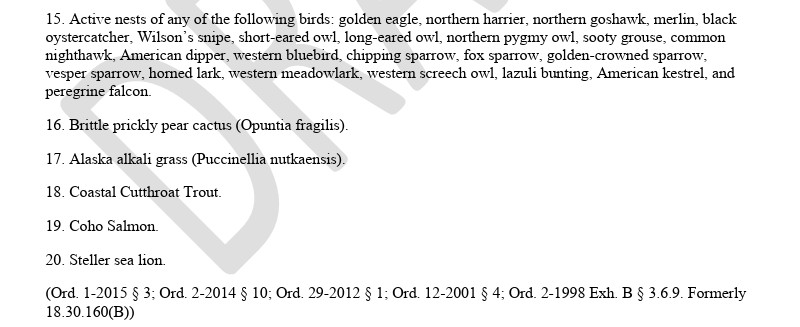
Share Under the draft 18.35.115 Fish and wildlife habitat conservation areas – Types of fish and wildlife habitat conservation areas (FWHCAs), I do not see Coho Salmon (Oncorhynchus kisutch) or Coastal Cutthroat Trout (O. Clarkii Clarkii) listed as priority species. They, however, are both noted in the 2022 Salmon Recovery Chapter Update & Multi-species Conservation Plan (see Reference 1 below, page 7).
I previously submitted a county docket in 2018, and again in 2020, to designate Coastal Cutthroat Trout as species of local importance based on earlier salmon recovery discussions and known protection problems (see Reference 2 below, page 2). The 2020 docket 20-0006 was approved by DCD with recommendations to "consider during the critical area code update following the plan update" (see References 3 & 4 below). Council approved DCD’s recommendations and only questioned the timing for final completion (see Reference 5 below, starts ~ 0:39:00).
I would like to know if these species will be included in the 2026 CAO update? Not including them would go against previous Council Council’s recommendations, Best Available Science, and ultimately, fail to protect these vulnerable salmonid species within San Juan County.
REFERENCES:
1. https://www.sanjuancountywa.gov/DocumentCenter/View/25143/Salmon-Recovery-Plan-Update-February-2022_Final
2.https://salishsearestoration.org/w/images/a/aa/Rot_et_al_2019_san_juan_islands_salmonid_limiting_factors.pdf
"The Technical Team asks San Juan County for a designation of salmonids and other native fish as Species of Local Importance to highlight their existence and critical stewardship need by private landowners and discourage stocking of non-native fish in priority watersheds." (pg. 2)
3. https://www.sanjuancountywa.gov/DocumentCenter/View/20761/2020-07_02_2020_Annual-_Docket_PC_Public_Hearing_Presentation
4. https://www.sanjuancountywa.gov/DocumentCenter/View/20898/2020-07-28_DCD_Docket_transmittal_Cassam_CC_08-25-2020
5. https://media.avcaptureall.cloud/meeting/c48f8ee5-85c2-4418-9b8f-f50942c483af DCD and Council's recommendations for Docket 20-006 on 8-25-20 (~0:39:00).
on Facebook
Share Under the draft 18.35.115 Fish and wildlife habitat conservation areas – Types of fish and wildlife habitat conservation areas (FWHCAs), I do not see Coho Salmon (Oncorhynchus kisutch) or Coastal Cutthroat Trout (O. Clarkii Clarkii) listed as priority species. They, however, are both noted in the 2022 Salmon Recovery Chapter Update & Multi-species Conservation Plan (see Reference 1 below, page 7).
I previously submitted a county docket in 2018, and again in 2020, to designate Coastal Cutthroat Trout as species of local importance based on earlier salmon recovery discussions and known protection problems (see Reference 2 below, page 2). The 2020 docket 20-0006 was approved by DCD with recommendations to "consider during the critical area code update following the plan update" (see References 3 & 4 below). Council approved DCD’s recommendations and only questioned the timing for final completion (see Reference 5 below, starts ~ 0:39:00).
I would like to know if these species will be included in the 2026 CAO update? Not including them would go against previous Council Council’s recommendations, Best Available Science, and ultimately, fail to protect these vulnerable salmonid species within San Juan County.
REFERENCES:
1. https://www.sanjuancountywa.gov/DocumentCenter/View/25143/Salmon-Recovery-Plan-Update-February-2022_Final
2.https://salishsearestoration.org/w/images/a/aa/Rot_et_al_2019_san_juan_islands_salmonid_limiting_factors.pdf
"The Technical Team asks San Juan County for a designation of salmonids and other native fish as Species of Local Importance to highlight their existence and critical stewardship need by private landowners and discourage stocking of non-native fish in priority watersheds." (pg. 2)
3. https://www.sanjuancountywa.gov/DocumentCenter/View/20761/2020-07_02_2020_Annual-_Docket_PC_Public_Hearing_Presentation
4. https://www.sanjuancountywa.gov/DocumentCenter/View/20898/2020-07-28_DCD_Docket_transmittal_Cassam_CC_08-25-2020
5. https://media.avcaptureall.cloud/meeting/c48f8ee5-85c2-4418-9b8f-f50942c483af DCD and Council's recommendations for Docket 20-006 on 8-25-20 (~0:39:00).
on X (formerly Twitter)
Share Under the draft 18.35.115 Fish and wildlife habitat conservation areas – Types of fish and wildlife habitat conservation areas (FWHCAs), I do not see Coho Salmon (Oncorhynchus kisutch) or Coastal Cutthroat Trout (O. Clarkii Clarkii) listed as priority species. They, however, are both noted in the 2022 Salmon Recovery Chapter Update & Multi-species Conservation Plan (see Reference 1 below, page 7).
I previously submitted a county docket in 2018, and again in 2020, to designate Coastal Cutthroat Trout as species of local importance based on earlier salmon recovery discussions and known protection problems (see Reference 2 below, page 2). The 2020 docket 20-0006 was approved by DCD with recommendations to "consider during the critical area code update following the plan update" (see References 3 & 4 below). Council approved DCD’s recommendations and only questioned the timing for final completion (see Reference 5 below, starts ~ 0:39:00).
I would like to know if these species will be included in the 2026 CAO update? Not including them would go against previous Council Council’s recommendations, Best Available Science, and ultimately, fail to protect these vulnerable salmonid species within San Juan County.
REFERENCES:
1. https://www.sanjuancountywa.gov/DocumentCenter/View/25143/Salmon-Recovery-Plan-Update-February-2022_Final
2.https://salishsearestoration.org/w/images/a/aa/Rot_et_al_2019_san_juan_islands_salmonid_limiting_factors.pdf
"The Technical Team asks San Juan County for a designation of salmonids and other native fish as Species of Local Importance to highlight their existence and critical stewardship need by private landowners and discourage stocking of non-native fish in priority watersheds." (pg. 2)
3. https://www.sanjuancountywa.gov/DocumentCenter/View/20761/2020-07_02_2020_Annual-_Docket_PC_Public_Hearing_Presentation
4. https://www.sanjuancountywa.gov/DocumentCenter/View/20898/2020-07-28_DCD_Docket_transmittal_Cassam_CC_08-25-2020
5. https://media.avcaptureall.cloud/meeting/c48f8ee5-85c2-4418-9b8f-f50942c483af DCD and Council's recommendations for Docket 20-006 on 8-25-20 (~0:39:00).
on Linkedin
Email Under the draft 18.35.115 Fish and wildlife habitat conservation areas – Types of fish and wildlife habitat conservation areas (FWHCAs), I do not see Coho Salmon (Oncorhynchus kisutch) or Coastal Cutthroat Trout (O. Clarkii Clarkii) listed as priority species. They, however, are both noted in the 2022 Salmon Recovery Chapter Update & Multi-species Conservation Plan (see Reference 1 below, page 7).
I previously submitted a county docket in 2018, and again in 2020, to designate Coastal Cutthroat Trout as species of local importance based on earlier salmon recovery discussions and known protection problems (see Reference 2 below, page 2). The 2020 docket 20-0006 was approved by DCD with recommendations to "consider during the critical area code update following the plan update" (see References 3 & 4 below). Council approved DCD’s recommendations and only questioned the timing for final completion (see Reference 5 below, starts ~ 0:39:00).
I would like to know if these species will be included in the 2026 CAO update? Not including them would go against previous Council Council’s recommendations, Best Available Science, and ultimately, fail to protect these vulnerable salmonid species within San Juan County.
REFERENCES:
1. https://www.sanjuancountywa.gov/DocumentCenter/View/25143/Salmon-Recovery-Plan-Update-February-2022_Final
2.https://salishsearestoration.org/w/images/a/aa/Rot_et_al_2019_san_juan_islands_salmonid_limiting_factors.pdf
"The Technical Team asks San Juan County for a designation of salmonids and other native fish as Species of Local Importance to highlight their existence and critical stewardship need by private landowners and discourage stocking of non-native fish in priority watersheds." (pg. 2)
3. https://www.sanjuancountywa.gov/DocumentCenter/View/20761/2020-07_02_2020_Annual-_Docket_PC_Public_Hearing_Presentation
4. https://www.sanjuancountywa.gov/DocumentCenter/View/20898/2020-07-28_DCD_Docket_transmittal_Cassam_CC_08-25-2020
5. https://media.avcaptureall.cloud/meeting/c48f8ee5-85c2-4418-9b8f-f50942c483af DCD and Council's recommendations for Docket 20-006 on 8-25-20 (~0:39:00).
link
Under the draft 18.35.115 Fish and wildlife habitat conservation areas – Types of fish and wildlife habitat conservation areas (FWHCAs), I do not see Coho Salmon (Oncorhynchus kisutch) or Coastal Cutthroat Trout (O. Clarkii Clarkii) listed as priority species. They, however, are both noted in the 2022 Salmon Recovery Chapter Update & Multi-species Conservation Plan (see Reference 1 below, page 7).
I previously submitted a county docket in 2018, and again in 2020, to designate Coastal Cutthroat Trout as species of local importance based on earlier salmon recovery discussions and known protection problems (see Reference 2 below, page 2). The 2020 docket 20-0006 was approved by DCD with recommendations to "consider during the critical area code update following the plan update" (see References 3 & 4 below). Council approved DCD’s recommendations and only questioned the timing for final completion (see Reference 5 below, starts ~ 0:39:00).
I would like to know if these species will be included in the 2026 CAO update? Not including them would go against previous Council Council’s recommendations, Best Available Science, and ultimately, fail to protect these vulnerable salmonid species within San Juan County.
REFERENCES:
1. https://www.sanjuancountywa.gov/DocumentCenter/View/25143/Salmon-Recovery-Plan-Update-February-2022_Final
2.https://salishsearestoration.org/w/images/a/aa/Rot_et_al_2019_san_juan_islands_salmonid_limiting_factors.pdf
"The Technical Team asks San Juan County for a designation of salmonids and other native fish as Species of Local Importance to highlight their existence and critical stewardship need by private landowners and discourage stocking of non-native fish in priority watersheds." (pg. 2)
3. https://www.sanjuancountywa.gov/DocumentCenter/View/20761/2020-07_02_2020_Annual-_Docket_PC_Public_Hearing_Presentation
4. https://www.sanjuancountywa.gov/DocumentCenter/View/20898/2020-07-28_DCD_Docket_transmittal_Cassam_CC_08-25-2020
5. https://media.avcaptureall.cloud/meeting/c48f8ee5-85c2-4418-9b8f-f50942c483af DCD and Council's recommendations for Docket 20-006 on 8-25-20 (~0:39:00).
Jenny deGroot
asked
7 months ago
Hello Ms. DeGroot,
Thank you for taking the time to write.
On page 32 of the published 'clean' draft regulations under SJCC 18.35.115(J) Species of local importance #s 18 and 19 are Coastal Cutthroat Trout and Coho Salmon.
Respectfully,
Colin



 Best Available Science Supplement
 Public Comments November 2025

Thank you for your contribution!
Help us reach out to more people in the community
Share this with family and friends